Wednesday, April 2, 2014

Kivunim participants build exciting connections with GPM volunteers

Jewish peoplehood came alive at GPM when participants from Kivunim, a Jewish gap-year program encountered GPM Entwine Spring 2014 volunteers. The meeting, which took place at the famous Mumbai landmark Knesset Eliyahu Synagogue in late March, was facilitated by GPM Program Coordinator Sigalith Isaac Kurulkar. Sigalith introduced the Kivunim group to GPM’s work with vulnerable children in the slums of Mumbai, exploring the impact of GPM nutrition, health, hygiene and literacy initiatives. GPM volunteers described their day to day work in the slums of Mumbai and the experiences and challenges of living in Mumbai while caring for marginalized children. The groups exchanged insights, ideas and emotions about the roles and responsibilities of the Jewish people in caring for vulnerable children of the world.

Kivunim is a unique gap-year program built on the philosophy of instilling in young Jewish adults a “world consciousness”. As part of the Kivunim vision of Jewish education and peoplehood, participants experience an intensive academic and experiential encounter with Middle Eastern, North African, Asian and European cultures. Kivunim participants study and travel to a dozen different countries, where the history of Jewish life demonstrates the powerful integration of surrounding cultures into the rhythm and experience of Judaism, fostering a strong identity rooted in knowledge of Jewish life while engaged with the international community.

Special thanks to Kivunim Founder and Director Peter Gefen for relaying his support in saying that GPM is doing “such magnificent work!”

The GPM team looks forward to more encounters with Kivunim.

Monday, March 17, 2014

When Purim and Holi fall out on the same day!

When (Shushan) Purim falls out on the Hindu holiday of Holi it means a whole lot of fun in Mumbai!

Take a look at this picture gallery for a whole lot of Purim/Holi excitement...

Holi color war!

Adina at Chabad Purim Party in Mumbai

GPM fellows and JDC staff preparing Mishloach Manot and Matanot Levyonim

Chabad Purim Party in Mumbai

Itai at Chabad Purim Party in Mumbai

Organizing the Bollywood themed Purim Shpiel at the Mumbai JDC

Chabad Purim Party in Mumbai

Rebecca at Chabad Purim Party in Mumbai

Chabad Purim Party in Mumbai

A Bollywood Purim Party at the JDC

Pre-Purim visit to JDC's Bayiti Jewish old age residence in Mumbai

Class before Holi in the slums

Pre-Purim visit to JDC's Bayiti Jewish old age residence in Mumbai

Pre-Purim visit to JDC's Bayiti Jewish old age residence in Mumbai

Pre-Purim visit to JDC's Bayiti Jewish old age residence in Mumbai

Thursday, March 13, 2014

Womans Day empowerment celebrations - News from REAP

On 8th March 500 women from REAP's Self Help Groups (SHG's) from Ghatkopar area came out in large numbers to celebrate Women's Day.An impressive  rally began from Ghatkopar Station, Mumbai and wound its way to the crowded market area where it culminated in a street show with a big stage right in the middle of the market.

The rally was accompanied with the beat of drums and their own women leading with the 'legim' dressed in colourful traditional sarees. The road show was a delight with women putting up a variety of entertainment skits, dancing and song. With celebrations through the night, the entire experience was one of of unity and solidarity. Many  local municipal corporations were present and lent their support to make it a success. Similar celebrations were held in Kalwa, Kalyan and Dolkhamb, Shahapur Taluka.

The pictures say it all:


Tuesday, March 11, 2014

Israeli Diplomat in the Slums of Mumbai

When Mr. Matan Zamir, the Deputy Head of the Consulate General of Israel in Mumbai joined Gabriel Project Mumbai volunteers in the slums, it was a learning experience for everyone.

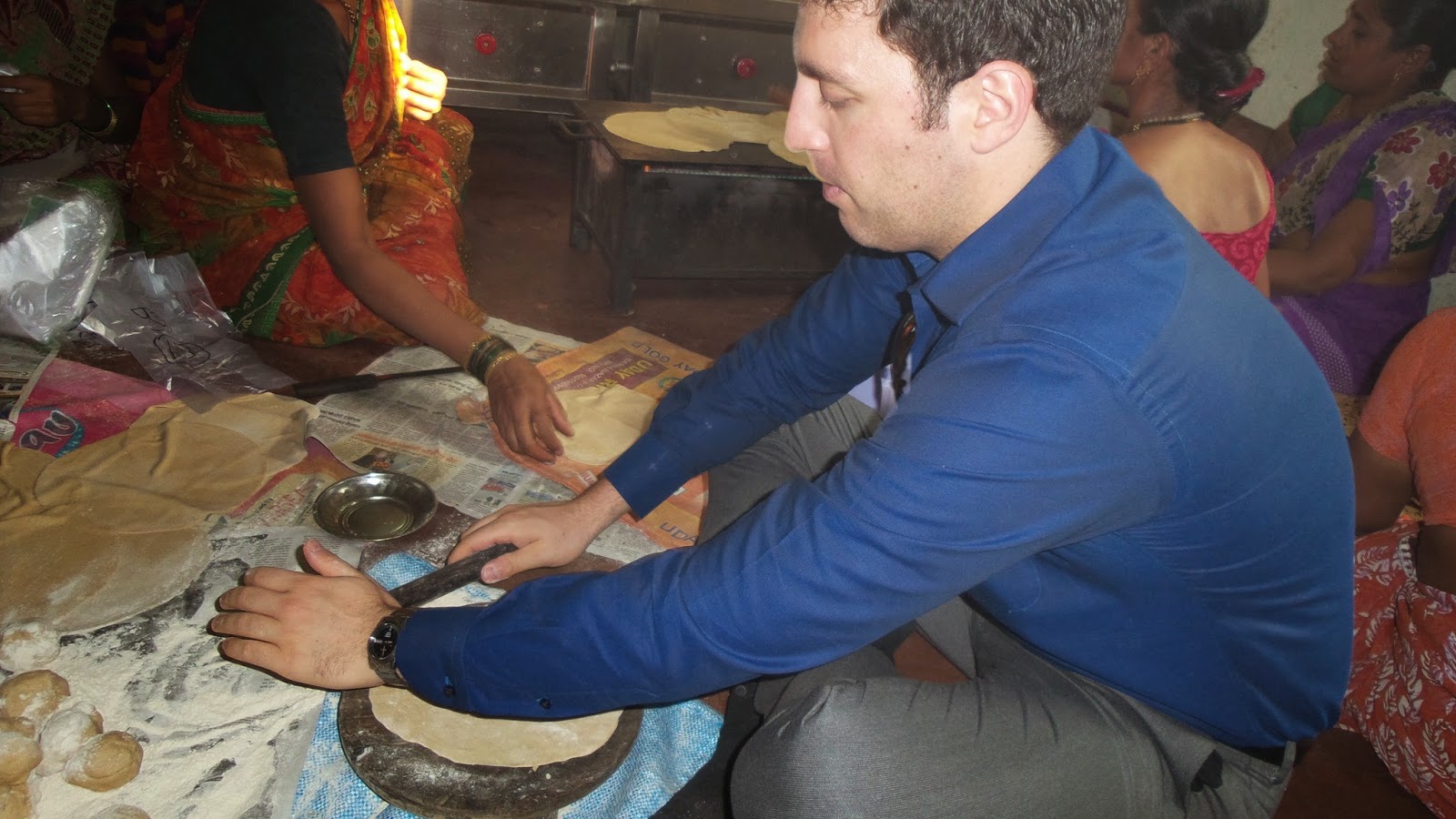
Mr Zamir’s first stop in the slums was the central kitchen used by the women from GPM’s grassroots partner, REAP as the base of GPM’s Nutrition Program for the children in the slums. Here Mr Zamir joined the 30 women, and GPM volunteers, in preparing chapattis (flat bread) and vegetable dishes for the 500 vulnerable children attending REAP classes in the slums. Mr Zamir showed exceptional talent in rolling the chapattis and the women were quiet impressed. (It took many days of practice before any GPM staff or volunteer were able to roll a chapatti that passed the quality assurance test of the women in the kitchen; Mr Zamir succeeded on his first try!)

After a 20 minute walk through the slums, Mr Zamir joined one group of GPM volunteers in teaching two classes. Upon entering the class the teacher asked the children if they remembered how to say ‘hello’ in Hebrew as Mr Zamir was from Israel. Having been taught a few words in the many languages of over 50 international GPM volunteers, it took just a little prodding for the children to scream out “Shalom!” Mr Zamir had a big smile on his face when he replied ‘Shalom, Namaste!’

The session was in art appreciation. The children were looking at pictures of famous sculptures, paintings, music and film, and learning to express their own impressions of the works. In addition to opening the children’s eyes to a world of beautiful artwork, the session also had an important message behind it. The children learned that they each have a unique and authentic voice, and it is completely legitimate and valid for each of them to express their own feelings and ideas about how they experience the art work. For vulnerable children this concept is very powerful because it is not a message that they often receive in their lives. But it was also difficult for the children to express their feelings. The children wanted to know what is the ‘right’ answer. They were eager to look at the art work before them and say this is good or bad. Faced with the challenge of trying to get the children to express their subjective and personal feelings, GPM volunteers tried many teaching methods but it was Mr Zamir who really brought out the children’s ideas. Mr Zamir simply asked the children, ‘Why?’ That is, ‘Why do you think the art work before you is good or bad?’ Slowly, the children expressed the reasoning behind their answers. “The dark colors of the painting makes me feel cold/lonely/sad…” or, ‘The smiling face makes me smile and feel happy’. Suddenly the children were excited to express their thoughts and feelings. For children immersed in an environment not conducive to self-expression, this lesson inspired and encouraged the children to value their feelings and opinions.

Mr Zamir had a memorable impact on the children, and we hope that the children had a memorable impact on him as well. He is always welcome to return for a visit to make chapattis and teach a few classes!

Matan Zamir preparing Chapattis

Mr Zamir outside one of the classes

Tuesday, March 4, 2014

Volunteer inspired Project H.E.A.L - Hygiene Encouragement Awareness Learning

Check out this great clip! I am so proud of the new hygiene initiative (H.E.A.L) conceived by the current batch of GPM-JDC Entwine fellows for vulnerable children in the slums of Kalwa, India. 

After a month of volunteering with Gabriel Project Mumbai in REAP classrooms in Mumbai, Simona, Benjamin, Adina, Shira, Itai, Rebecca and Ilana created this incredible initiative after seeing some children with rotten teeth and other physical ailments caused by lack of hygiene. 

Education and access are the key to health in the slums and the group is doing both: educating the children as to healthy/hygienic habits AND access to hygienic materials. Really beautiful...Help them out by donating here! http://www.rootfunding.com/campaign/4598

Click here to read more about GPM's 'H.E.A.L' Initiatives for children living in the slums of Mumbai.

Monday, March 3, 2014

Simona: From Slovakia to The Netherlands to Mumbai

Simona has always dreamed of spending time in the developing world working on alleviating poverty and hunger. Originally from Bratislava, Slovakia and now living in The Netherlands, the vibrant and intelligent 24-year-old is passionately committed to the welfare of children. She was searching for a way to taking part in an innovation to help children, and decided to volunteer with Gabriel Project Mumbai. After a month as a GPM-JDC fellow, she couldn’t be happier.

“This program is awesome,” says Simona, who holds a Master’s Degree in Political Science and a degree in Business Administration. “What we are exposed to makes me think about inequality in the world and how we can fight it. In Europe and in the West we have certain ideas about how to help the poor and vulnerable populations, but being here opens my eyes to the complexities of the challenge. I think through volunteering and experiencing the extreme conditions you also get to know yourself and who you are.”

Simona is part of the eighth cohort of GPM volunteers, which includes participants from all around the world including: United States, Israel, United Kingdom, Australia, Italy, France and now Slovakia! Simona, who is fluent in English, German, Dutch and Slovak and has spent time studying at Hebrew University in Jerusalem, lives with the other volunteers in the Mumbai neighborhood of Thane, close to the slums where the volunteers work every day providing nutrition and literacy to 750-school-age children. The volunteers are also located in proximity to the Jewish community of Mumbai with whom they collaborate on many facets of the program.
Simona, who spent two years as the President of the Slovakian Union of Jewish Youth president for two years, serving the communal needs of 120 Jewish youth and university students as well as the local Jewish community, is surprised herself at how attached she has become to the children. “I did not expect the children to show so much enthusiasm in learning,” she admits. “Their smiles when we arrive every day give us so much.”

Simona and the rest of the volunteers have in fact taken a keen interest in the dental hygiene of the children.  “I have a hard time seeing these children living with certain difficult realities,” she says. “There are some children, as young as 4 or 5, who have rotten and decaying teeth and even though they are now receiving good nutritious food from GPM, their teeth have rotted from years of malnutrition and neglect. It breaks my heart every time I see them smile.”
 
The group of volunteers decided to launch a program to help provide the children with toothbrushes, toothpaste and soap, as well as basic information about oral health, hygiene and healthy living. The program, called H.E.A.L., which stands for Hygiene Encouragement Awareness Learning , has raised over $1000 to date.

 For Simona, this wonderful achievement, which will drastically improve the lives of 750 children, is inspiring. “It is not difficult at all because the children are so worth it.”
Simona teaching a class

Simona participated in the Fifth Forum of the United Nations in Vienna, Austria, worked in the German Parliament and recently completed an internship at a Dutch engineering consultancy Royal Haskoning DHV in the field of corporate social responsibility with a focus on UN Global Compact. At the end of the program Simona will be returning to The Netherlands, where she will pursue a career in Corporate Responsibility. Thank you for being part of GPM, Simona and veľa sťastia-good luck!

Sunday, February 23, 2014

Jewish Indian youth caring for vulnerable children living in the slums

An integral part of the JDC-GPM volunteer experience is the inspiring sight of Jewish Indian youth connecting and caring for the vulnerable children in their society.

We welcome Doron, Shamir, Leya, and Shlomo to the 4th GPM-JDC Internship and we grateful to Osrah and Nikita who are participating in the Internship for a second time!

Last week the new cohort of Jewish Indian youth gave the children a  fun and educational day out at picnic to Girgaon and Chowpaty beach. For many this was the first time out of the slums - the first time seeing the ocean!


Tuesday, January 7, 2014

Final days in the Slums

by Jenny Samad, GPM-Entwine fellow winter 2013, an extract from her personal blog - Jan 7, 2014

“ This past week was our last in the slums and I cannot believe how fast time flew by the past few months. We taught about heroes this week and tried to present to the kids a few influential people from around the world, different ages, genders and time periods to inspire them. On Monday, we discussed the story of Malala the girl in Pakistan who defied the Taliban ruling which forbids girls to go to school. We set up a mock debate and split the kids into two groups and had one group represent the Taliban and the other Malala. Obviously everyone wanted to be on team Malala but it was interesting to see what the Taliban group came up with in their defense and I was really impressed with their creativity. On Tuesday we taught them about the Paralympics swimmer Ellie Simmons and stressed how one can achieve her dreams even when faced with difficult obstacles. We spoke about Tagore, a popular Indian poet who advocated for freedom during British imperialism in India. As he was the author of the Indian national anthem the kids stood up proudly to sing it for us; it was really cute. On Wednesday, we talked about Gandhi and his influence in India and around the world. We started the class with a little skit to illustrate Gandhi’s message of nonviolence with two of us acting like British and two of us representing India. We began the class by storming into the classroom with sticks screaming and clawing at each other. In the heat of the battle, Debbie, dressed with shawl and staff came quietly between both groups and shouted “Bass!” (the Hindi word for ‘Enough!). She continued with “brothers, sisters is this solving anything? BASS! Stop the violence!” Then we all hugged and bowed. A very dramatic performance if I may say so.
   
Thursday was our last day of class. So hard. We made a kind of graduation ceremony for the kids where we called each child up to the front of the class and presented them with a certificate, pencil, eraser and chocolate. It was really adorable how excited they got about receiving these small gifts. Then the class presented us with little gifts. In one class I got a light up Ganesh (the elephant headed god) and in the other class, a little snow globe. The day was really emotional and as we were saying goodbye I started tearing up and when one kid came to comfort me I just lost it. This set off some of the other volunteers until we were all in tears. I swear I saw tears in one of the teacher’s eyes too.

Looking back, my time working in the slums has been so incredible and leaving these children is not going to be easy.”


Wednesday, December 4, 2013

Quality education for all tribal children

GPM is so proud of its association with Reach Education Action Programme (REAP) that once again has shown incredible innovation in its campaign to give quality education to vulnerable children throughout India. With great foresight REAP has inaugurated a hostel for tribal children who would otherwise need to migrate from their villages when their families search for work to survive. The plight of vulnerable children in poor tribal families in rural India is exasperated when these families are required to migrate from their villages for up to six months of the year because a lack of seasonal work. Once a family migrates, the children’s education has for all purposes ended, guaranteeing a life of illiteracy and continued poverty. Indeed, among the Katkari tribes, migration to other cities to work at brick kilns and sugar factories is common.  Poverty and landlessness forces mass migration for their survival. Every year after the Diwali holiday, families migrate and return only in June.  They take their children along with them which means that their education is hindered as they are taken out of school.  This cycle is repeated every year and thousands of tribal children lose out on education.

REAP recognized the harsh consequences of tribal migration for children and last month opened a hostel for vulnerable children in the tribal hamlet in Lahe, Maharshtra.  Now, tribal children who would have migrated with their parents to work continue their education as they will stay at the hostel and continue their schooling uninterrupted until their parents return.   A beautiful feature of REAP’s program is the strong cooperation of the village residents themselves. Indeed one member of the tribe has given his house to be the ‘boarding’ for these children while two couples from the hamlet have volunteered to act as the children’s ‘parents’ and look after them.

REAP’s pioneering six month boarding program was initially a hard sell for the parents.  Several meetings were held with the villagers to encourage them about the plan.  Eventually the great merits of the program led to the hostel’s inauguration by REAP’s Director, Dr. Trevor Miranda, on November 20,  in the presence of the zilla parishad area development officials, head masters, school teachers,  village Sarpanch (village mayor) - who also happens to be a teacher in REAP’s program -, school children from the village and residents.  The school officials praised the unique project and said that this is a major step in providing all children a quality education.  The director announced that with the success of this pilot project, more boarding’s would be opened in villages to prevent illiteracy caused by migration.  The director also announced that REAP would provide toilets and solar lights in the village; the crowd cheered in appreciation!

REAP currently networks with about 100 Zilla Parishad Schools in Bhiwandi, Sange, Shahapur and Khardi area to bring quality education to tribal children.  REAP also runs a boarding for tribal girls in Dolkhamb, Shahapur to encourage tribal girls to complete high school.  Currently 40 tribal girls are studying there.
We commend REAP and its founder and director Dr Trevor Miranda for the pioneering dedication and commitment to the education of vulnerable children living in rural villages and urban slums.


Children at the November 20 hostel inauguration

REAP director Dr Trevor Miranda welcomed at the inauguration

Children singing at the opening ceremony

Tribal girls and boys listening to the inauguration speeches

The tribal hamlet in Lahe, Maharshtra