| ||
| ||
|

| ||
| ||
|
When Gabriel Project Mumbai (GPM) decided to open a cafe in the remote tribal village area of area of Mokhada, Maharashtra, last month, they hoped to garner some local interest and support. What they got was wild enthusiasm from both locals and those traveling through – and a public clamoring for more.

By the end of the first week, crowds gathering at the café – which is located on the main road artery in the district – the food was a hit!
The Gaja Café (‘Gaja’ being the Sanskrit word for ‘elephant’, an auspicious animal found in Hindu, Buddhist and Jain scriptural texts) was born as a response to the challenges faced by indigenous communities, who often endure disproportionately high levels of unemployment and poverty. The café was opened in order to catalyze positive change, uplift marginalized communities, provide jobs and serve some great tasting meals.
“This venture holds immense potential, with its focus on generating livelihood opportunities,

The Gaja Café, which offers a menu of Indian breakfast, lunch, snacks, health drinks and dessert items provides livelihood opportunities for six community members, including three cooks and three servers who have been FOSTAC (Food Safety Training & Certification) trained in the highest hygiene practices. The café shares industrial kitchen space with GPM’s Bal Balwaan/Healthy Child Malnutrition Intervention program that aims to treat infants diagnosed with Severe Acute Malnutrition (SAM).
“What I love most about the Gaja Café is that it draws people into our center where they learn about our

The cafe also showcases the rich culinary heritage of the local tribal communities, offering visitors an authentic taste of traditional tribal cuisine along with Western fare. Darshan Kharpade, Gaja Café supervisor emphasizes the cultural significance: "This café not only satisfies culinary enthusiasts but also celebrates and preserves the indigenous knowledge and culinary traditions of our tribal community. It fosters cultural exchange, appreciation, and a deeper understanding of our communities.” Darshan adds, “a main focus of the Gaja Café is to serve healthy food and the hygienic, zero-waste kitchen is environmentally friendly” with a compost bay in clear view outside the kitchen. Additionally, all food ingredients are locally sourced providing economic support to local farmers.
This initiative represents a paradigm shift in international development efforts, combining economic empowerment, cultural preservation, and sustainable progress.

The Gaja Café is expected to create a ripple effect, elevating the living standards of the tribal community while nurturing a sense of pride and identity. Furthermore, this model can serve as an inspiration for similar ventures in other remote areas, where development organizations can leverage local resources and traditions to foster sustainable change.
If you are in the area and want to drop into the Gaja Café, we are located in Mokhada Maharashtra at: https://goo.gl/maps/MNkHBoCdfxfADqNL6
(Operating hours are 8am till 5pm, six days a week –
vegetarian/kosher).

| ||
| ||
|
Some of the mothers we meet through our work at Gabriel Project Mumbai fill us with awe and inspiration for their courage and dedication – and their willingness to do whatever it takes to give their children a better life.

Jayshree: The mother willing to sacrifice everything for her child to eat
Jayshree, a 20-year-old new mother from the village of Sartuli in the tribal region of Maharashtra, was having trouble feeding her baby. She barely had enough food in the house for herself, but what she did have, she gave to her infant, often foregoing eating herself. At six months old, her baby was already suffering from malnourishment, as was she.
Jayshree approached GPM three months ago, and we immediately began treating her child through our Bal Balwaan/Healthy Child Infant Malnourishment Program, providing the baby with supplements and nutrients – while also making sure that Jayshree herself had nutritious food to eat.
.jpg)
But we realized that we needed to do more. Mothers must also eat, and Jayshree wanted to be strong enough to be able to provide food for herself and her family. Jayshree enrolled in one of our livelihood programs so that she can now earn enough money to make sure that both she and her baby will have what to eat.
At nearly one year old, Jayshree’s baby is now flourishing – as is Jayshree. And Jayshree is not alone.
In the last 12 months over 300 children have been treated for Severe Acute Malnutrition, 75% moving out of the danger zone of severely malnourished…
I am so humbled by Jayshree’s courage and strength, and I am proud that GPM has been a part of this mother’s journey of devotion to her family.
The mothers who want a computer education – like their children
Six months ago, a group of mothers from Kalwa whose children learn in our school, the Joshua Greenberger Learning Center, approached us with a special request. They said that the computer classes that we were delivering to their children was having a wonderful effect, that the kids were really enjoying it – and that they wanted to learn computers, too! Even though none of the women own computers, they understand the power of computer literacy and its role in gaining employment and breaking the cycle of poverty. They were determined to do whatever it takes to make changes in their lives, for themselves and for their families.

 |
For the past year the conscientious team of 16 social workers have gone out to the villages, homes and fields explaining the citizen rights, gathering documentation and applying for government services for the tribal communities of Mokhada.
Recently, the GPM-IsraAID team referred to in Marathi as ‘Adivasi Lokseva Kendra’ or ‘Tribal Rights Service Center’ secured the pensions of 200 individuals, registered birth and tribal status certificates for 5,000 people and applied for agriculture grants for hundreds of farmers. Referrals to psycho-social services were made to residents from government entities in various public health fields.

The teams going out to the 56 villages and hamlets do so in all kinds of weather. Last week the temperatures reached 44C/112F!). Soon the teams will endure heavy monsoon rains in their work providing essential services to the tribal communities.
Kudos to this dedicated team at GPM!


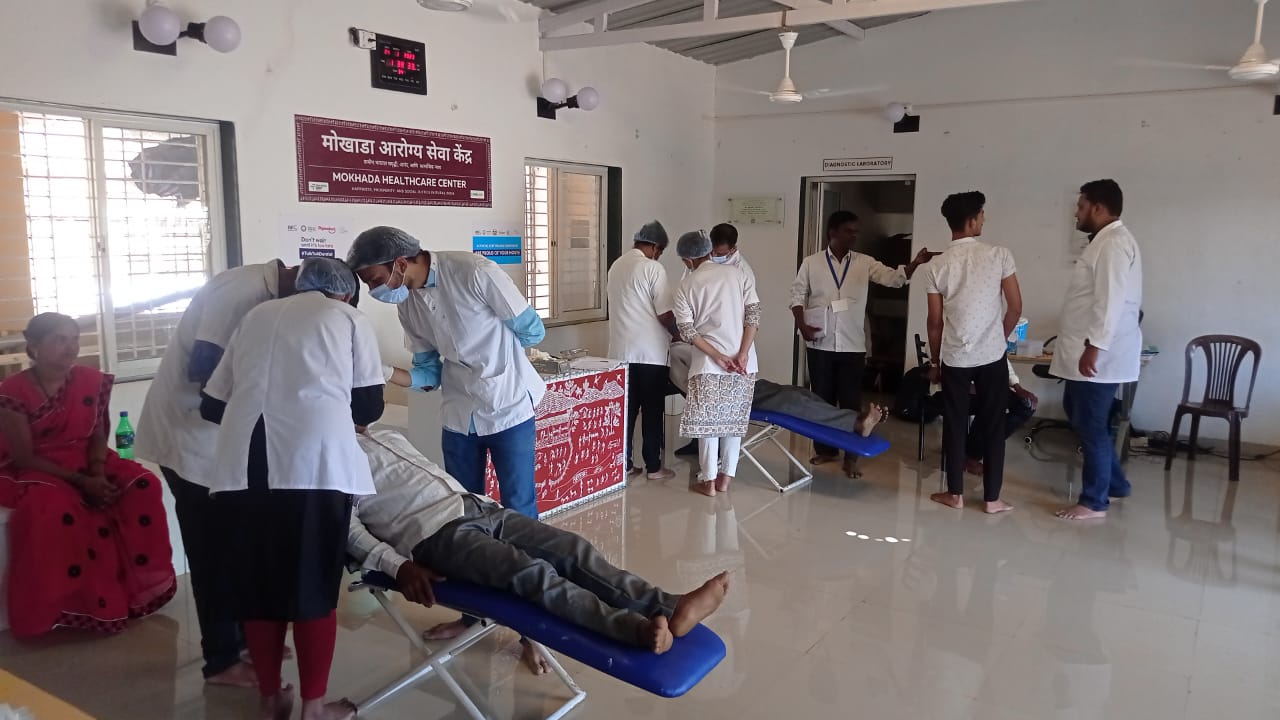
A free oral cancer screening program for thousands of people living in underserved villages in Maharashtra took place in March. As part of the state-wide Maharashtra Oral Cancer Campaign (MOCC), Gabriel Project Mumbai and the Indian Dental Association (IDA), provided life-saving oral health awareness and treatment in 40 remote underserved hamlets in the Mokhada sub-district.
As part of the MOCC, specialist dentists and doctors provided services free of cost and additional referrals for specific complex treatments. Of the 2000 people participating in the program, 84 patients with signs of oral cancer were given cancer biopsies. These biopsies were sent to laboratories for analysis. Additional dental care activities based at the GPM ‘Mokhada Community Health Center’ included home visits, blood samples, scaling, extractions, and GIC restoration (filling of cavities and fixing tooth deformities).

“The ongoing oral health care program spearheaded by GPM and the IDA is saving many lives from oral cancer by treating the cancers at an early stage and, most importantly, through education and community awareness, said GPM India Director Kenneth Dsouza. “Preventive health care is the key to long-term health of our community service participants.”
The first phase in this program, which took place in July 2022, was the “Oral Health Screening Camp”

The second phase that took place in March
2023 focused on the people in need of treatment or those showing symptoms of
oral cancer. Patients from the North and the South will be brought to the
health center for counselling, blood tests, biopsy, and basic treatment.
Phase three will focus on the treatment of
those based in south Mokhada along with counselling of patients.

 |
| GPM medical staff and Indian Dental Association dental staff go over logistics of the oral healthcare screenings |



Over 2,200 people died last year in India due to natural disasters and extreme weather events. Heavy monsoon rains, flooding, and extreme tropical cyclones are devastating, but people living in underserved

The GPM Rural Emergency Response Program that began during
Covid has launched a ‘First Responders’
training course to support the 57 villages of Mokhada in times of natural
disasters. The training course, which takes place at the GPM medical clinic,
the Mokhada Community Healthcare Center, is being taught by expert government
trainers to fifty participants, including five GPM staff, in life-saving methods
and
techniques to use in climate emergencies.
“We hope that this cohort of first responders will receive
the knowledge and skills that they need to save lives of people living in Mokhada,”
said GPM India director Kenneth Dsouza. “I’m proud that we at GPM are able to
serve the community in such a vital and meaningful way.”


IsraAID mental health professional Anva Ratzon is delivering Mental Health and Psychosocial Support (MHPSS) trainings to Gabriel Project Mumbai teams in order to equip them for working in the tribal communities in India. The two-week training will provide GPM staff with skills and techniques for supporting the community in regulating stress and promoting self-care.
 |
| Ms Ratzon delivering trainings on MHPSS at GPM Center |
The critical issue of mental health is often overlooked in marginalized communities that are experiencing the emotional and psychological stresses of living in extreme poverty.
“How can we talk about mental health in a community with no food or livelihood security?” posed Ms. Ratzon, a social worker specializing in community MHPSS, to the participants. “These communities are the ones that most need resources to manage their own mental health,” she emphasized.
“There is a general fear amongst community members that working on mental health is akin to having a
 |
| GPM Social Protection Team in a break during trainings |
Ms. Ratzon has visited several primary health centers in the sub-district of Mokhada that GPM is working with, and has sat with government health workers, village leaders to evaluate a general needs assessment of the villages in Mokhada.
The MHPSS trainings will be taking place over the next few weeks, with follow-up throughout the year. GPM staff, who have been engaged in community social protection awareness campaigns through an ongoing partnership with IsraAID – will now be able to offer mental health and psychosocial support to 56 tribal communities.

 |
| Anva Ratzon visiting Washala Primary Health Center, Mokhada |


