Thursday, April 25, 2013

From the slums to Mumbai's Nehru Centre of Art and Culture

On Sunday April 21, JDC-GPM Interns, JDC & GPM staff and REAP teachers, traveled with children aged 7-12 from the slums of Kalwa to the Nehru Center in Worli, Mumbai. For all 40 children, this was their first time visiting metropolitan Mumbai. For most, it was their first time out of the Kalwa slums. So of course, this was the first time they were at a museum and it would be a day they will always cherish.

The JDC-GPM Internship Program, an innovative four-month long volunteer opportunity for young Jewish Indian professionals and students, work with the children of the Mumbai slums to make a meaningful difference and a positive impact on their lives. Through an organized program of social and learning experiences the participants of the JDC-GPM Internship Program provide an informal, motivational setting to encourage social and personal growth for children with limited opportunities. Find out more about The JDC-GPM Internship Program here

The bus ventured out of the slums towards Mumbai. Ten minutes after leaving the slums, the children were overhead speaking to each other in amazement as they saw some of the tall modern buildings that dot the more influential parts of Mumbai. They understood that the people living in theses apartment buildings had water, electricity and food in their homes while the children’s family’s homes had none of these ‘comforts’…

The Nehru Centre houses 14 galleries that make up the Discovery of India Exposition, covering every aspect of artistic, intellectual and philosophical attainment of India through the ages. Its 50,000 exhibits and interactive audio visual displays, determine, true identity of the country. The Centre was chosen specifically to introduce the children to their India. The interactive exhibits brought to life prestigious Indian personalities like Gandhi, Nehru, Tagore and Akbar. The most impressive part of the museum was the professionally made movie, ‘Who Are We?’ that traced the incredible history and development of the Indian people throughout the ages. We wanted the children to be exposed to the many cultures, religions, traditions and people that are part of their identities as citizens of India. We wanted the children to appreciate that they were significant members of the multicultural and ethnic makeup of their wonderful country. We wanted to instill in them the idea that they are important and that they can contribute and thrive in their society.

The museum and the beautiful gardens surrounding the centre were idyllic locations for the fun activities prepared by the Indian Jewish counselors.  The well developed program, masterfully led by JDC-GPM Intern, Jennifer Jacob, was well-structured and the children thoroughly enjoyed themselves. The children enjoyed the games and learning activities facilitated by Tahl Mayer, Salome Abraham and Sigalith Isaac of the JDC and GPM. Everyone appreciated Elijah Jacob, Director of JDC India taking time out of his busy schedule to interact with the children, especially as he brought chocolates for all! Once again, the JDC sponsored a wonderful nutritious breakfast and a nourishing lunch; something that the children did not take for granted! 

The JDC-GPM youth are important actors of social change. They are special people giving the equally special children living in the slums the message that they are loved, that they can follow their dreams and thrive.
Jennifer leading an activity

Salome showing a boy how proud she is of his work

Salome and Tahl with the children hard at work

Tahl and the kids at the Nehru Centre

Mr Elijah Jacob and friends


Sunday, April 21, 2013

The Good People Fund supports Gabriel Project Mumbai in alleviating the suffering of children in the slums

The Good People Fund, a wonderful  tzedakah  fund (charity) whose motto “Small actions, huge impacts” refers to their dedication to ‘low overhead organizations, run by “good people” who use creative ways on making strong inroads in easing poverty, hunger, disability, social isolation and more’, has granted Gabriel Project Mumbai a generous donation to support our work.

When we approached the Good People Fund, they were touched and moved by our commitment to providing hunger relief and literacy for children living in India’s slums. They heard about the hardships and suffering (malnutrition, child labor, illiteracy and hunger) of the children and families living in the slums and then they took action. The Good People Fund decided to generously support the nutrition and literacy of more than 50 children living in the slums over the course of one school year.

Gabriel Project Mumbai appreciates the goodwill of the Good People Fund and thanks them for their support and their dedication to giving many children living in the slums a life of hope and the opportunity to thrive.

To learn more about the good work done by the Good People Fund, click here. To learn more about how you can make a meaningful difference in the lives of vulnerable Indian children, click here

Sunday, April 14, 2013

Join us at a GPM event at Boston's historic Vilna Shul!

Join us at the historic Vilna Shul, in Boston on Sunday 12th May (4pm) to hear about Gabriel Project Mumbai's work with vulnerable children in the slums of Mumbai and celebrate the rich history, vibrancy and traditions of the Indian Jewish community:


Giving of Ourselves
Exploring Jewish India with Gabriel Project, Mumbai founder Jacob Sztokman

 NEW DATE: May 12th at 4:00pm
18 Phillips Street, Boston, MA
Take the Red Line to Charles/MGH

Join us at the Historic Vilna Shul for a special event as we celebrate the richness of global Jewish life and the groundbreaking work of the Gabriel Project, Mumbai.
Founded in 2011, the Gabriel Project works to inspire the worldwide Jewish community to take action in the slums of India. At the core of the organization are young Jews from around the world who dedicate their time to teaching literacy and providing nutrition for children living in Mumbai’s slum. Volunteers are placed in the program through the JDC's Global Jewish Service Corps.
Jacob’s organization is a stunning example of someone who combines a Jewish ethos with the Jewish historical experience and uses it to motivate others to lift people out of the bondage that is poverty.
If you are interested in serving abroad, learning about Jewish cultures, or are simply curious about what it is like to live in India, join us on April 21st.  
We will hear Jacob’s inspirational story of his work founding the Gabriel Project and afterward enjoy entertainment and refreshments, including European Ashkenazi foods alongside sweet flavors unique to Jewish India.  This event is free and open to the public, so bring your friends!

What is the Vilna Shul?
Boston’s last remaining immigrant-era synagogue, the Vilna Shul is now a place of learning where Jewish history, culture and spirituality are open and accessible to everyone. It is a must-see historic site for visitors to Boston and a unique community venue for concerts, speakers, films and Jewish life cycle events.

For information and registration visit www.vilnashul.org or contact 
Jessica at (617) 523-2324.

Thursday, March 28, 2013

Pesach and Holi: Breaking free to care

At first glance, it is difficult to see the similarities between the Jewish Passover holiday and the Hindu festival of Holi, both celebrated this week. The Passover story is based on the One God who took the Jewish people out of slavery and made them into a nation. The Holi polytheistic mythology is based on events by demons and deities leading to the salvation of a pious son (Prahlada) over his tyrannical demon father. The two back stories seemingly cannot be any more different. Nevertheless,  they do share one interesting characteristic that I realized last week while volunteering with vulnerable children in the slums of Mumbai.

In celebrating Passover we get rid of the leavened bread in our homes, a very strong commandment by God to the Jewish people who were freed from Egypt with only unleavened wafers (Matzah) in the sacks on their backs. The rabbis teach us that leavened bread (Chametz) symbolizes the excess that we have in our lives, whether material goods, swelling egos, inflated self-importance or other things in our lives that imprison and enslave our true selves. So we are told to get rid of the excess and unchain ourselves from the dependence on meaningless things that often fill our lives. The eating of simple matzah makes us free to think about what true liberation is to us. The goal is to be free.

Holi’s most enjoyable ritual for kids (and the young at heart) is a fantastic custom of throwing colored powder (Abeer) on friends and strangers alike. One idea behind this joyous ritual is that Holi marks the beginning of Spring and we all should be grateful, and take time out of our work day to enjoy the beautiful colors seen in nature at this time of year. Additionally, as it was explained to me, the throwing of bright colors causes all types of people to forgo their individual ‘look’ and join the multitudes of people on the streets, casting off their status, type of clothes, and ego in order to unify together in a brilliant show of brotherly harmony, breaking free of convention and rank.

Both holidays stress the importance of casting our egos aside to achieve a certain amount of freedom. But freedom as an end-goal is incomplete.  At the Passover Seder we invite all those who are hungry to join in our meal. We talk about the awful effects of slavery and discuss current social justice troubles in the world. And at Holi, many Hindus perform Holi Milan, visiting many people, singing songs and promoting the brotherhood among the people.

In both holidays, the message of freedom leads to the encouragement of care and love for others. The goal of freedom is not that we are just free but that we make this world a better place. This is the true meaning of freedom, and social justice for all is the true meaning of liberty.

Chag Sameach, and Happy Holi to us all!


Sunday, March 24, 2013

Greatest Indian Jewish Youth Cricket Tournament in history!

GPM volunteers were honored to be invited to participate in the annual Jewish Youth Pioneers Cricket tournament sponsored by the JDC India and the local JCC. Held at the courtyard of the Sir Elly Kadoorie High School, a famous Jewish  landmark, the forty Jewish youth were divided into four teams eager to claim the winners trophy. Armed with cricket bats and the determination to beat their opponents, the teams began to battle in the day long 'box cricket match'.

The natural talent of the local players was quickly apparent but soon a MVP emerged from amongst the GPM ranks. His first time playing cricket, Josh from Ohio proved to be a great fielder, bowler an batsman. At times the innings were intense and the rapid pace of the bowling and batting got the better of several batters who attempted to hit the balls out of bounds. There is no doubt that the sporting spirit of Sachin Tendulkar, Sir Donald Bradman and Sunil Gavaskar entered the psyche of the players during this match! The match went on for several hours with a break for lunch and a little socializing.

Many thanks to Salome Abraham of the JDC and the great sportsmen and sportswomen of the JYP for an incredible experience and a most enjoyable day.


Thursday, March 21, 2013

There Is No Place Like India

The following blog post is copied from a GPM Spring 2013 session participants' personal blog. The session ended yesterday. Erin, 19 really captures some of the deep lessons one learns from service with the children living in the slums. We found her insights profound and we are grateful for sharing her ideas and feelings with us all:

Thursday, March 21st - 7:23 p.m. - Paridhi Apartments, Thane Nth Mumbai

As I sit down to write what will be my last Mumbai blog post, I am experiencing a lot of mixed emotions. In a few hours, I will leave Mumbai and travel to Sydney, Australia where I will be living and working for a couple of months. Although I am looking forward to that, I now feel that India has become my home. Things that used to make me turn my head, I now overlook as normal. I feel absolutely indebted to this land and its people for everything it has taught and shown me. I have seen and felt immense sadness and hardship, and I have seen unbelievable joy. I have seen images that will haunt my mind forever, and I have witnessed things I will never forget.

I have had crazy adventures in the police office, and seen cows and goats grazing on trash. I have been amazed to see crowds of Indians standing in line to buy train tickets, when it would be just as easy to simply hop on without paying. I have seen that women can do almost every job that men do and many more. I have watched cricket matches, and my photograph is on a billion Indian peoples’ cameras that I will never see again. And only in India have I seen an oxcart walk straight down the street as I sit in Baskin Robbins.

I have learned that humans are capable of not being wasteful. We visited an old-fashioned family-operated oil press in which, after extraction, the leftovers are used as fertilizer. People find uses for other people’s trash. Things most of us would find meaningless and worthless are sorted through, re-used and sold. Food is never wasted, and all parts of a slaughtered animal are put to use.

It was here in India, that for the first time, a beggar allowed me to buy them food, and it is here in India that all the different world religions find a way to live together in harmony. I have blessed a bride and groom on their wedding day, and I have perfected the art of bargaining (well… almost); and I have witnessed the most magical nights here in this city.

India has taught me to be thankful- that you can always find the positive in seemingly negative situations. When I first came, I was slightly annoyed that our shower floor was the same thing as our bathroom floor, and it would always be flooded with water. But why should I be annoyed? It cleans itself! Our showers are always cold? So many out there cannot escape the heat! Gratefulness is everything. It helps us to see things in a completely different light. When riding the train through the city, I see so much poverty around me. So many live in such poverty, and I have nothing to be but thankful. I do not feel bad for people, or guilty myself for not being born into poverty, because I personally believe in karma and life lessons and that we are where we are meant to be in life. However, that does not change the fact that we must always be grateful- in every area of our life and with every fiber of our being. It is also a mistake to believe that the things we own constitute our abundance, when in reality, it is what we choose to appreciate and enjoy that can make us feel like the luckiest person in the world.

India has shown me that I can impact people’s lives so immensely without my knowledge –that it is difficult to comprehend the effect your actions can have on another.

I would like to share a beautiful example of this. The other day, we took a group of about thirty kids from the slums on a field trip to a beautiful park by a lake. With the exception of one child, none of them had ever left the slums. They were so, so excited, and were all dressed up in their finest clothes. After hours of games and laughter, it was time for us to take the children home. As they were boarding the bus, one little girl said, “Today must have cost so much money for you all- the bus, the games, and so much good food… Why did you spend so much time and money on us, instead of spending it on yourselves?”

Wow. For me at least, the day had felt effortless. We got to spend the day by a beautiful lake on a gorgeous afternoon and play games with children. It hadn’t seemed like a big deal to me. Although I knew they were probably in awe of the foreign world outside the slums, I hadn’t really thought about what they were thinking of us. But when I heard about the words that this beautiful child spoke, it made me think. Such an easy, normal thing for us to do was absolutely life-changing for these kids. We showed them a joyous and fun day, and for a few hours, took them out of the heat and poverty of the slums where they spend every day of their lives. But it was more than that. We showed them that they are worthy, that they are important, and that there are people out there who care about them.

Similarly, I have spent five days a week over the past two months in classrooms helping to teach these children in the slums. But it didn’t feel like work to me. The sweet smiles and the “Good morning, teacher!” that would greet me as soon as I saw them made it all worth it. Every day, the time I had with them would fly by. But I started thinking about this, as well. Not only had I helped to teach these kids lessons that would provide for them a foothold to one day leave the slums, but I had shown them, simply by my presence, that they matter, that their education is important, and that we want them to make the most of their lives. Being a teacher is not just about what you teach to your students, but about how you are coming across to them and the lessons you are silently conveying. Much of the learning in this world is acquired without verbal language. Therefore, it is important to always choose the kind path. Smile at everyone and be compassionate, let your intentions be good ones, and give with your whole heart.

Overall, I feel that living in India has been a big confidence booster for me. I feel so strongly that wherever I am, whoever I am with, and however I feel, I am never, ever alone. There is help and love available to me from every angle and from every dimension. I feel at peace, and there is no need to fear the world or anything in it. Every soul in this universe is the same although there is an illusion that we are all separate and different. We can see ourselves in another’s eyes if only we look deeply enough, and although we don’t always speak the same language, we can understand each other’s hearts and humanity. True communication goes beyond; it is a language of the heart.

One of the most important things? Enjoy the simple pleasures of life. Live life with every sense that you have, and process the world around you with your entire mind. A few weeks ago, while standing on a beautiful beach with a light breeze, staring out into a golden sunset with wet sand between my toes, these words came to my mind: “We as humans rarely stop to enjoy the present moment. We are always thinking of places we wish we could be and then once we are there, we become bored very quickly. This is because the holy grail of contentment does not lie in any external place or possession, but from within. So many come to believe that happiness is a destination, when in reality, it is a manner of traveling. Be thankful for what you are given, and use that to bless others’ lives. Instead of always thinking bigger, next, and more, think NOW. For now is all there is.”

Since coming here, I have heard from so many people: “India can make or break you.” or “You either love India or you hate it.” There is a lot of truth in these statements, but for me, it has been a lot about attitude. New things are going to seem foreign at first, but with a positive attitude, you can turn every situation into a learning experience, and even a joy.

Two weekends ago, as I was cruising in the back of a rickshaw down a rural road on the coast, I experienced absolutely happiness. It was as if everything else in my life just melted away and it was only me and the present moment- and pure happiness. Apparently I had the biggest smile on my face because I was asked why I looked so happy. Grinning, I said the first thing that came to my mind. “Because I AM so happy. I’m so fortunate to be here – it’s beautiful. What reason do I not have to smile?”

I am so grateful to my parents for allowing me to take this leap of faith and make this journey. Doing things “by the book” is not mandatory for a fulfilling life. I hope that now and in the future, you all will have the strength and insight to know what is best for yourself. Remember, if you ever find yourself getting discouraged by the small things, weighed down by life… Just stop for a second. Reflect. Imagine life as a whole. Expand your viewpoint. There is so much more to the world- so many people, and oh so much to live for. Never lose hope in the place that you find yourself in, mentally or physically. See problems as a chance to excel, and always keep your head up.

In conclusion, I would like to share a quote from my favorite movie, The Curious Case of Benjamin Button.

"For what it's worth: it's never too late or, in my case, too early to be whoever you want to be. There's no time limit, start whenever you want. You can change or stay the same, there are no rules to this thing. We can make the best or the worst of it. I hope you make the best of it. I hope you see things that startle you. I hope you feel things you never felt before. I hope you meet people who have a different point of view. I hope you live a life you're proud of, and if you find that you're not, I hope you have the strength to start all over again."

Love and blessings,

Erin

Tuesday, March 19, 2013

Leaving the slum for a day of fun

Our bus entered a large, dusty, debris-filled clearing on the outskirts of the Kalva slums. It was Sunday morning and the slums were teeming with people, buffalo, dilapidated auto-rickshaws and wild boar. The decrepit bus had difficulty maneuvering on the one-lane dirt road, but eventually we made it to the group of people we had planned to meet. Thirty children were huddled together in the middle of the clearing, oblivious to the commotion around them and visibly excited to see the bus heading towards them, some standing on the balls of their feet to get a better view of THEIR bus. For most of the children, today would be their first time on a bus, and for all but one child, it would be the first time out of the slums.

‘Fun Day’ is a special program for the children living in the slums of Mumbai that is taking place as part of The JDC-GPM Internship Program, a joint initiative of JDC India and Gabriel Project Mumbai supported by the local NGO, REAP. The JDC-GPM Internship Program is an innovative new four-month long volunteer opportunity for young Jewish Indian professionals and undergraduate students to work with the children of the Mumbai slums. In this program, participants make a meaningful difference and a positive impact on the lives of youth living in the slums of Mumbai through an organized program of social and learning experiences. While REAP’s dedicated teachers provide professional formal education, the participants of the JDC-GPM Internship Program provide an informal, motivational setting to encourage social and personal growth for children with limited opportunities. The brainchild of JDC Country Director for India, Mandie Winston, this program is the first initiative that brings together young Indian Jews and Jewish volunteers from around the world to collaborate on providing literacy and nutrition support in the Mumbai slums. Find out more about The JDC-GPM Internship Program here

With enormous smiles and lots of giggling, the children aged 7-12 found their seats on the bus. The first thing the GPM volunteers – who teach the children on a day-to-day basis – noticed is that the children had put on their finest clothing for this special day. They were wearing the outfits they used for festivals, adorned with plastic costume jewelry, and combed their hair. It was apparent that their families and/or the children felt that this was indeed a special day, and I prayed that we would not disappoint them!

The bus ventured out of the slums and picked up Jennifer, Leora and Shamir, three Fellows of the The JDC-GPM Internship Program as well as Salome Abraham Program Coordinator for Young Adults, JDC India. Later we were joined by Tahl Mayer, Global JSC fellow at JDC. GPM staff, Sigalith and Hayley as well as GPM international volunteers, Erin, Josh, Jessica and Debra also participated.

We arrived at Upvan Lake, Thane. The location was perfect and the children were fascinated with the beautiful, serene site. Immediately, the Indian Jewish youth took control and split the group into three teams. They would be working together as teams in fun and challenging activities. The ulterior motive for all the games was to teach how to play with others, team building and camaraderie. The program was well-structured. Games and challenges were well-thought-out and the children thoroughly enjoyed themselves. The children were encouraged to use their imaginations, work together as a team and enjoy the day. The JDC had sponsored a wonderful nutritious breakfast and a nourishing lunch and the children loved the cake dessert which added to the joyful feeling in the air.

The saddest part of the day was when we were nearing its end. It looked like the children wanted to stay longer and although we were really tired, we wanted to stay longer with the beautiful children as well. Back on the bus a ten-year-old girl nestling her head on the shoulder of one of the Indian Jewish youth asked, “Why did you waste so much money on us today? The bus, so much good food and the games must have cost a lot of money. Why didn’t you just take the money and spend it on yourselves?” What followed was to me the best part of the day: the volunteer replied, “Because you are so special and we wanted to be with you!”

I think the JDC youth and GPM volunteers are so special giving the children living in the slums the message that they are important, that they can follow their dreams and can achieve greatness.


Sunday, March 17, 2013

My Birthday in the Slums

March 6th was my birthday and for some reason I felt like celebrating. Forty three is not an unique birthday, nevertheless I felt like marking the day in a special way.  The problem was that I was in Mumbai, away from my family and friends; volunteering with Gabriel Project Mumbai (GPM). I was expected to go into the slums  that day, along with the other volunteers, to help GPM’s nutrition and literacy efforts for the children living in the slums. I went along with my colleagues, a little begrudgingly, knowing that my birthday wouldn’t be marked in any special way.

We started the day jumping in an auto-rickshaw for the 15 minute ride to the slums – five international volunteers and GPM staff. We walked over to train tracks that marked the beginning of the slums, where 80,000 people live – about a third of them children. We proceeded down the winding narrow alleyways till we arrived at a small room where a few local women greeted us with words of sincere welcome (in Hindi) and large smiles. I have spent many hours with these women over the past year and they have graciously accepted me as a friend. We have spent countless hours preparing nutritious food for the 500 children attending the classes in our particular slum. We have also chatted, talked about our lives, joked around and laughed a lot. The women have invited us to their homes on all the Hindu holidays and offered us a taste of festive foods (I am looking forward to Holi next week as the women have invited us for breakfast and to partake in a sweet treat prepared for the holiday.)

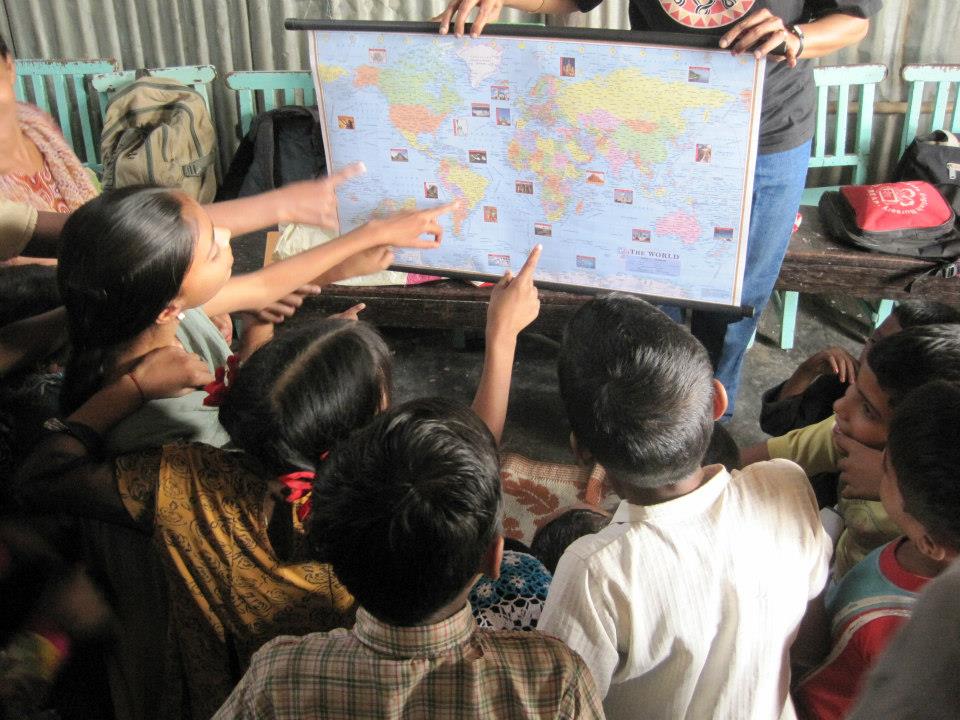
While the children’s food was being cooked on the gas burner, the volunteers and I trekked twenty minutes through the slums and taught three classes. The lesson plan for two classes that day was a revision on the continents, where they are on the world map, which major countries are in each continent and a few animals that are unique to each continent. The GPM volunteers were fantastic! With the invaluable help of the GPM staff translating difficult English words into Hindi, the volunteers inspired and motivated the beautiful children with valuable information, fun classes and a lot of care. The greatest moment was when the children sang ‘The Continent Song’ taught to them by one of the volunteers, Erin, earlier in the week. With loud confident voices the kids reminded us ‘not to forget Australia and Antarctica’ in the list of the world’s seven continents (growing up in Australia, I find that line quite funny!) In a few days the children who live with so little and have never seen a map before, understood that they belong to a larger community of many people’s, each nation unique in its own right. In a subtle way, we hope to instill the idea that we are all part of a large vibrant planet and that we can all achieve greatness.

The third class we gave was a lesson on the solar system. Here too the GPM volunteers showed incredible ingenuity with limited teaching materials. Each child was given a planet, a ball, that they were to represent and act out their orbit around the Sun. Slowly children/planets were circling the sun, spinning in their respective orbits. Soon ‘moons’ were added and shortly the small metal hut was full of activity…and giggles…

Soon after, the children’s meals arrived and they began to eat food that adds nutrition and health to their lives; providing active minds the fuel to imagine, wonder and explore.   

During the long walk back through the slums, and in scorching heat, I realized that I was smiling. I realized that the work we are doing is helping disadvantaged children in a profound way. I realized that the women in the slums are empowering themselves and benefiting from microcredit system we have in place. On a selfish note I realized that this birthday was very special. Come to think of it, I did spend my birthday among friends and family. --Jacob

Jacob Sztokman is the director of Gabriel Project Mumbai

Wednesday, March 13, 2013

Let Everybody Teach and Inspire You, No Matter How Young

As my time in India begins to near its end, I wanted to share some of the observations I've made about the kids I have been so fortunate to work with and help teach.

Almost every single one of these children is the very first in their families to receive an education. I applaud the parents so much that have chosen to take this new and unknown step and allow their child to attend school. They want their child to learn English, to be literate, to learn about the world, in hopes that they will have a better life than themselves. If their son or daughter does not go to school, it is more likely than not that they will never leave the slums; they simply won't have the skills necessary to hold a decent job. We are hoping that through our endeavors, our small contribution to this large issue, we can help to break the cycle of poverty in the Kalva slums. As well as the literacy and nutrition program our organization has for the kids, we are also implementing the creation of women's groups who not only are paid by the organization to cook and cater to the schools, but who will also receive aid in making their own arts and crafts to advertise, market, and sell. We are hoping that this enterprise will help uplift and empower these women, giving them a purpose and a job, as well as skill development. But that's a different story.


During my time her with Gabriel Project Mumbai, I have learned ever more that it's not always what you're teaching, but how you're teaching it - the way in which you come across to your students and the unspoken messages you are bringing to them. It had never really occurred to me before, but a few weeks ago, something profound was brought to my attention. Simply the few of us being here meant so much in the way that it is showing these people just how much education means. It is always amazing when walking down the street, someone will ask us what we are doing here and when we tell them, they are absolutely stunned and inspired. Although it doesn't feel like I'm doing much or really even working since it brings me such joy, the locals are always amazed and so incredibly thankful that we have come to do such a nice thing in their country.

The happiness these children have brought me is indescribable. I cannot wait to see their bright little faces every morning and the 20 minute trek through the 100 degree slums is always, always worth it.

After teaching Sunday school classes for a little while in the U.S., it is plain to see that there are huge discrepancies between  these slum children and the typical affluent American child. The amount of respect that these kids have for their elders in general, let alone their teachers, is awe-inspiring. It is something I have rarely seen back in America. Each morning, they all stand up to face us and say "Good morning, teacher," as each of us walks in, and then remain standing until we tell them they can sit. When someone asks them to do something, they do it. They are respectful in class, and it is easy to tell that they have a genuine love of learning.

The classrooms that these children are studying in are made of corrugated metal with cement floors. There are nails sticking out everywhere. The children sit on the floor. Some classes have a small, old ceiling fan to help dissipate the hot, thick air, but many do not even have that. One schoolhouse we taught in was about the size of a closet and was an entire half of someone's house. There were about fifteen kids crammed in this one room, and we all barely fit inside.


Outside of the classroom, I am equally amazed. A lot of the children I see on the streets have absolutely nothing. They live in tiny shacks with dirt floors, no refrigerators, and just enough food to survive on. They have no shoes, and their entertainment consists of walking around outdoors, chasing chickens and poking through trash. The interesting thing? I don't sense much sadness when I walk through the slums. If you read my earlier posts, you will remember I believe that limited distraction can seem like a curse, but actually be a tremendous blessing. These people don't NEED cellphones. They don't need tons and tons of money. These children don't NEED video games or fancy toys or television. They derive their entertainment and their pleasure from the tangible world around them - their environment. At times, the way they play may seem dangerous, sure. Many frollick in the trash-filled streets with no shoes on, digging, playing with sticks and anything else they can find on the ground, filling up plastic bags with rocks, chasing after marbles, and dragging each other around on dirty sacks. But the truth is, they're having fun. You can see it in their faces. They appreciate every little thing that comes their way, which is how I strive to be. They bond with each other, playing games together while shouting and laughing. So yes, these kids are poor, yes, they run around in the streets, but they get to keep those all-too-often-lost-too-soon things called "imaginations."

Because they have so little, the simplest things bring them so much joy. I gave Muskan, a little nursery school girl a small green ball the other day and the way her eyes lit up and that smile spread across her face, well, it nearly brought tears to my eyes. A couple days later when I saw her again, she immediately took the ball out of a small pocket of her bag and I taught her how to play catch, which basically kept us occupied for about thirty minutes. And may I say, it was one of the best thirty minutes of my life.

Two days ago, we taught them about fruit and we had brought some for them to try. Even after seeing the food we'd brought, they stayed calm, and when we passed it out, they would deliver it around the group to the others instead of keeping the first thing in their hand for themselves. They did not snatch, try to steal more, or lie about not getting any. From their behavior, one would never guess how well these children knew hunger.

Today, also, we had a lesson in which we introduced them to pizza. Only one kid out of probably 40 had ever had it before. There were some mixed reactions to it, so it was funny to observe the apparent taste preferences present in different cultures. However, nothing was wasted. These children were appreciative. And most of them loved it, ate their whole piece and said it was delicious.

While handing it out, we saw one little girl putting the pizza away in her lunchbox instead of eating it. When we asked her why she was doing this, she replied "I'm taking it home for my mom."

Lesson? These kids may be dirty... They may have no shoes. But they do have what it takes to capture all of our hearts with their sweet smiles, their integrity, and their hearts.
Erin is a GPM-Entwine Spring 2013 participant. This post is can be found in her personal blog.