Wednesday, January 27, 2016

Welcome Adit Goschalk to the GPM team in Mumbai

We are so excited to welcome Adit Goschalk from London to the GPM team in Mumbai. Adit will facilitate training and educational programs for Gabriel Project Mumbai volunteers and develop an educational curriculum for the children in our care. She will also be working with the local staff to evaluate GPM’s model and impact.

Adit's involvement with GPM is part of her service as a JDC-Pears Fellow, supported and funded by the Pears Foundation. Adit will also focus her efforts on working with the JDC India team and the Indian Jewish community.

Adit has been teaching Art and Design for over five years since completing the Teach First programme. Prior to this, Adit spent several months working in Rajasthan supporting women’s empowerment workshops and running creative arts workshops for children in slum schools. In London she has run similar workshops in a homeless shelter. Adit is an artist and her work has been exhibited and sold in Belgium, the UK and the US.

Adit teaching about family and community through the medium of art 

Adit with children from the slums at an outing

Wednesday, January 13, 2016

Chief Rabbi of UK visits GPM in the slums of Mumbai

The Chief Rabbi of the United Hebrew Congregations of the Commonwealth , Rabbi Ephraim Mirvis, visited the Kalwa slums in Mumbai India this week to observe firsthand the work of Gabriel Project Mumbai (GPM) with vulnerable children in education, nutrition and health. The Chief Rabbi gave lessons to the children of two classes in the slums, met with educators of REAP education network, visited a women's empowerment kitchen that produces hundreds of meals for GPM's Nutrition Program, watched a soap recycling demonstration by hygiene partner, Sundara and affixed a mezuza on the door of the newly established Shravan Health Center.
Chief Rabbi Mirvis, his wife Valerie and two of their sons at the kitchen in the slums where local women prepare meals for the children

“God has been protecting Jews for thousands of years through this little scroll,” Rabbi Mirvis told the crowd as he stood under the doorframe putting up the mezuza, a little box containing a parchment with the words of the Shema prayer on it that have been placed on Jewish homes since the time of the Exodus from Egypt over three millennia ago. “My wish is that, through this mezuzah, God will protect all the people who come through this door seeking medical care.”
Chief Rabbi Mirvis affixing the mezuzah on the entrance of the Shravan Health Center

The Shravan Health Center, which was established by GPM and Doctors for You in August 2015, serves 10,000 mothers and children in the Kalwa slum. The clinic marks the first time that the 200,000 Hindu and Muslim residents have readily available access to quality medical care. The clinic was built in memory of 11-year-old Shravan Sahu a GPM student who died of a treatable case of the flu in June 2014, because his family had no access to medical care.

“I’ve met the Queen of England,” Rabbi Mirvis told the children, ages 4-12 who sat rapt listening to his lesson. “I’ve been to palaces and castles, and even saw the Taj Mahal! But you know what is the most wonderful thing that I have seen? Its YOU!” The children – and many of the adults listening to his class – were deeply moved by his sentiment.
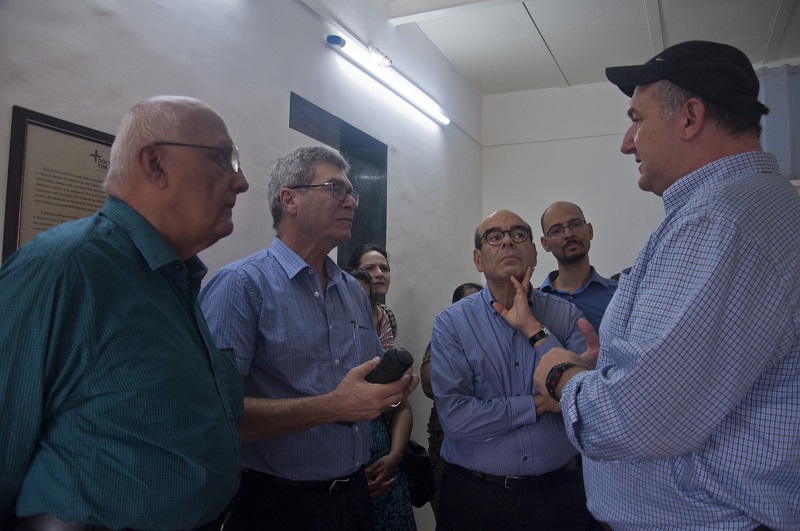
Chief Rabbi Mirvis talking with the children in the classrooms

“Rabbi Mirvis really gets what we are doing here,” said GPM Founding Director Jacob Sztokman. “He profoundly appreciates what it means to lift up a child’s spirit, and to impact their lives by reminding them that they matter. That is the essence of our work, and he powerfully and sincerely articulated that to the children and everyone else. When he said that the children are the most important people he has ever met, he really meant it.”

Rabbi Mirvis was born in South Africa in 1956, and served as Chief Rabbi of Ireland for ten years, and then as a congregational rabbi in London, before becoming Chief Rabbi of the U.K. in 2012. In a candid discussion at the Chabad of Mumbai on the previous Shabbat, Chief Rabbi Mirvis credits his mother, Freida, who was principal of the Athlone Teachers’ Training College during apartheid — at the time the only college for black teachers of pre-school children in South Africa- for instilling in him the importance of caring for vulnerable populations. The Chief Rabbi, spoke about his childhood under Apartheid South Africa, he watched his mother work in the black townships and that taught him the value of Jewish service among non-Jewish groups. In fact, before arriving in India with his wife Valerie and two of their children, Noam and Eitan, the Chief Rabbi had been visiting Syrian refugees in Greece.

“I have three goals in this position,” Rabbi Mirvis explained to the GPM staff and volunteers over Shabbat lunch. “The first two are obvious, but the third is not. The first goal is to educate the Jewish community. The second goal is to develop and strengthen Jewish communities. The third goal, which I have chosen to bring to this office even if it less obvious, is to reach out beyond the Jewish community and serve vulnerable populations around the world.”

Indeed, it was entirely the Chief Rabbi’s idea to visit GPM. His office contacted OLAM, an initiative designed to help advance the global Jewish service movement, global volunteering, aid and development, and OLAM directed the office to GPM. GPM also included Sundara, another OLAM coalition partner, in the Rabbi's visit to the Mumbai slums, where he observed the Sundara hygiene workshop.

The Chief Rabbi also met with the leadership of REAP, the award-winning NGO that provides classes in the slums and with whom GPM has a foundational partnership.

“Tikkun Olam, the idea that we have a responsibility to fix what is broken in this world, is a fundamentally Jewish concept,” the Chief Rabbi has said.

"The Chief Rabbi's visit to the slums in Mumbai was an act of 'chizuk'-encouragement- to all those working in community development for undeserved vulnerable groups", said Sztokman. "He brought a specific message of hope and optimism to the women and children struggling to survive in difficult conditions. We all will remember the message he gave us.'

To support the work of GPM, click here
Chief Rabbi Mirvis and GPM director Jacob Sztokman with the mezuzah at the enterance of the Shravan Health Center

Chief Rabbi Mirvistalking with the doctors and GPM staff at the Shravan Health Center

Chief Rabbi Mirvis and family with one of the REAP classes supported by GPM

Chief Rabbi and Rebbetzin Mirvis with Jonathan Goldstein from London in the Kalwa slums

Chief Rabbi Mirvis and family and others at Sundara hygiene center in Kalva slums


Thursday, December 24, 2015

The story of Anju

Anju has lived in the Bhaskar Nagar slums in Kalwa all her life. At a young age her parents saw that she was a clever child and made it a priority for her to receive an education. This was no easy feat as Anju's parents were struggling just to survive in the slums of Mumbai.  Anju was part of the only 10% of children who continue their education in highschool; most children enter the work force at age 12. After finishing year 10 Anju was selected by ourpartner organization, REAP, to teach in one of their classes in the slums. Anju taught for 5 years and was admired for her professionalism and dedication to her students.  Indeed Gabriel Project Mumbai (GPM) volunteers enjoyed working with her while giving informal classes to the children in her class. Anju married and has a beautiful boy Ansch.

In 2015 Anju joined GPM's Shravan Health Center as the clinic community outreach coordinator. Her connection to to the medical clinic is very strong as she was Shravan's teacher for many years including when Shravan tragically passed away [Read more HERE]. Anju is excited with her new occupation as she manages outreach health programs for her community with the guidance of the doctors and medical staff.

GPM and our partners Doctors For You are glad to have Anju join our team and work together to make a profound impact on her community.


Anju showing a group of GPM volunteers from Princeton University (Center for Jewish Life) her medical kit that she takes with her on house visits to pregnant women in the slums. Anju has been trained to take blood, pressure, measure sugar levels check fetal heartbeats, and other basic medical procedures.

Anju and other medical staff outside the Shravan Health Center

Wednesday, November 25, 2015

Bringing GPM to the East Coast of the US

In a series of talks around the East Coast of the Unites States, GPM's founding director Jacob Sztokman, spoke about the enormous challenges faced by children living in acute poverty in India and how GPM is caring for the health, nutrition and education of thousands of vulnerable children in the slums.

Gabriel Project Mumbai wants to thank its many supporters who came out to the talks in New York City, West Hemstead NY, Teaneck NJ, Stamford and Greenwhich CT and Chicago IL.

Much thanks goes to Sarah Gribetz who hosted  a parlor meeting at her home in NYC. Thanks to the three GPM alumni - Shayna Lebovic (GPM alum 2012), Melissa Rutman (GPM alum 2013) and Harmony Richman (GPM alum 2014) who attended and discussed their time volunteering with the children in the slums of Mumbai. Thanks to David Marlyles for sponsoring the GPM event at the Chabad of West Hempstead. It was great to hear the vounteer perspectives from Hayeem Rudy and Rena Kirshblum (both GPM alumni 2015). The Teaneck event was at the lovely home of Debra Hoffman and Alan Brill. Local resident Jenny Samad (GPM alum 2013) spoke about her volunteer experience with GPM in Mumbai where her grandmother was born and raised . In Stamford CT at the home of GPM board member Gladys Delman Teitel, the presentation was peppered with insights from Perry Pickei and Debra Feinberg (both GPM alumni 2014). Also in Connecticut,


Sztokman spoke to students at the Bi Cultural School in Stamford and with students at the Carmel Adademy in Greenwich. Rabbi Isaiah Rothstein (GPM alum 2014) the Spiritual and Experential Teacher at Carmel Acadamey spoke about his time volunteering with GPM. The students at both schools had great questions and the were moved by the presentations.


In Chicago at the home of Carol and Bob Minkus, there were several doctors in the audience as well as the parents of current GPM-JDC volunteer Erin Dopplet. Sztokman emphasized the amazing work of the 'Shravan Health Center' a GPM-Doctors For You initiative providing health care to tens of thousands of people in the slums.

The presentations spread awareness of the incredible community development work done by Gabriel Project Mumbai in the slums and poor rural villages.

Hadassah Magazine on Gabriel Project Mumbai

In Hadassah Magazines fantastic article "Nuturing Mumbai Dreams"(Nov 2015) Rahel Musleah writes about Gabriel Project Mumbai's goal of caring for the children living in the slums of India. Read more HERE

Sunday, October 4, 2015

The First Month of the GPM/Doctors for You 'Shravan Health Center'

What an amazing month we had at the Shravan Health Center in the Bhaskar Nagar section of the Kalva Slums in Thane, India!

609 patients were treated by the good doctors and nurses of Doctors for You in September '15 [Thank you doctors Kamraan, Gill, and Amit!]

Patients included 89 babies and toddlers, 97 children between 5-12 years of age, 407 children
Dr Kamraan with one of the residents
of the Bhaskar Nagar slums
above 12 years of age, women and men and 16 senior citizens.

Illnesses treated included: Fever, respiratory infections, breathing problems, and skin infections (Scabies, fungal infections etc)

Ms Anju Mishra, a local resident, serving as the center's Community Health Educator, is launching an outreach program to mobilize the community in accessing quality health care from the Shravan Health Center.

SHC's in-house pharmacist Mr Price Ja has been busy distributing medicines and coordinating medical treatments at SHC.

The Center's hygiene partner, Sundara, has distributed hundreds of bars of quality recycled bars of soap and is launching a community run hygiene awareness class in the coming months.

Certainly there is a lot more work to be done but this is an incredible start!  We are grateful for SHC's activity and professionalism and seeing the community based medical clinic really having a positive impact on the overall health of the residents of the slums!

Click HERE for more information on the Shravan Health Center
Click HERE to support the Shravan Health Center

[SHC was made possible with the support of the AJDC, The Estelle Friedman Gervis Family Foundation, Altico Capital India, Awakening Women’s Institute, Modern Trousseau and Sundara Fund and others]


Monday, August 17, 2015

New life-saving children’s medical clinic opened in the Mumbai slums

Mr Sharma, Shravan's father cutting the ribbon of the
opening of the Shravan Health Center with Mr Nimrod
Assouline of the Consulate General of Israel in Mumbai
 and Dr Ravikant Singh of Doctors For You
16 August 2015, Mumbai – A brand new medical clinic for children and mothers of the Kalwa slum was opened last week, thanks to the working partnership between Gabriel Project Mumbai and Doctors for You. The Shravan Health Center, which will provide medical services for a community of 200,000 people, including thousands of children and hundreds of prenatal/postnatal women in Kalwa, was named in memory of Shravan Sharma, an 11-year-old boy who died last year due to lack of accessible health care in the slums.

“This clinic is a life-saving initiative for the children of the Kalwa community who until now had no access to basic medical care,” said Jacob Sztokman, founder of Gabriel Project Mumbai that spearheaded the initiative. “Shravan’s death was a wake-up call about how many preventable deaths there are among children in the slums. This clinic will be transformative for the entire community, saving lives of children and promoting basic health and medical care.”

The clinic, which was made possible with the support of the American Jewish Distribution Committee, The Estelle Friedman Gervis Family Foundation, Altico Capital India, Awakening Women’s Institute, Modern Trousseau and Sundara Fund, opened with a festive ceremony on August 13 where Shravan’s father cut the ceremonial ribbon. The event was also attended by the Deputy Counsel General of Israel in Mumbai Mr Nimrod Assouline and his wife Dana, JDC representatives from Israel and India, REAP directors, Shravan's teachers, doctors, nurses and other health professionals and over 80 members of the Kalva slums community. (The Shravan Health Center needs your help, please donate here: http://www.rootfunding.com/campaign/medical-clinic-india)

The Bhaskar Nagar slums in Kalva is home to a wonderfully vibrant but 

underserved community. The Shravan Health Center is the only clinic in the

immidiate area which will provide accessible health care for

women and children in the community of 120,000 people
The slums of India are also home to over seven million children under the age of 14 who are growing up in poverty with limited access to electricity, clean water, food, and educational opportunities. Slums have overcrowded communal bathroom facilities and many have open sewage that contaminates sources of clean drinking water. The lack of adequate sanitation, nutrition and safe water has significant negative health impacts. It was estimated in 2002 by the World Health Organization that around 700,000 Indians die each year from diarrhea. According to the New York Times, 42.5% of the children in India suffer from malnutrition. The World Bank, citing estimates made by the World Health Organization, says that about 49 per cent of the world's underweight children, 34 per cent of the world's stunted children and 46 per cent of the world's malnourished children, live in India.
Mrs Anju, Shravan's teacher spoke about Shravan
and the importance of the health center in his name

The clinic will help offset this harrowing reality by providing services including: sick visits, minor acute care, treatment for burns and injuries, immunizations, health and nutrition education, prescription assistance, preventive checkups, and referrals to specialists. Other services include curative services, preventive health check-ups, growth monitoring, periodic de-worming, Vitamin A and Iron Folic acid supplementation, and minor procedures like cleaning and dressing The clinic will also provide free vaccinations and immunizations, some inexpensive or free medicines, and will have a special fund to subsidize advanced treatments that need to be conducted outside of the clinic, such as blood tests and x-rays. An estimated 80 % of the children will be managed with available facilities. The remaining 20% with more serious issues that require referral or hospitalization will be assisted during their protracted procedures.

Doctors for You, a partner organization in this project that has had great success in providing comprehensive health services for underprivileged populations in Indian slums for the past seven years, offers curative and health promotive services such as general health, immunization, family planning, dental, ophthalmic services, tuberculosis prevention and control and physiotherapy and neuro rehabilitation. In two other slum areas where DFY has opened clinics, the organization has achieved 100% immunization coverage among children below five years of age in the area.

The outside of the Shravan Health Center in the slums of Kalva. 

The clinic will provide health services to thousands of children as well

as antenatal and neonatal care to hundreds of women. The list of 

services include: General Health Check ups, AnteNatal Care for pregnant woman,
Immunization for children, DOTS (TB) services, Family planning services, 
Growth Monitoring clinic for children and hygiene education. 
The clinic will also has its own pharmacy dispensary!
“The impact of this clinic will be enormous,” Mr Sztokman added. “At GPM, we have been providing nutrition and literacy for children for the past three years. But when Shrawan died, we realized that this is not enough. We also need to be providing basic health care. This triad of health, nutrition and literacy is the formula necessary for real transformation and giving these beautiful children a real chance at life.”

The Shravan Health Center is a two-room center open five days a week, between 9AM-2PM, with regular evening operations Monday, Wednesday and Friday 6PM-9PM to meet the needs of working parents. The clinic will be staffed by a pediatrician, a general practitioner, a nurse and an administrative manager. It is estimated that the staff will be able to service an average of 45 patients a day, approximately 200 patients a week, or almost 10,000 women and children a year.

Additional hygiene and health workshops will be run for the children and community in general from
Representatives of the JDC International and JDC India
 receive a tour of the Shravan Health Center
the clinic after operating hours. The focus of the workshops will be hygiene, disease prevention and promotion of healthy living. The community outreach team made up of local women who will be trained as health representatives in the slums and led by a social worker, will go house to house giving vaccinations, and providing basic health-care education. Partner organizations will work hand in hand with the community outreach team to encourage families to utilize these services.


The Shravan Health Center needs your help, please donate here: http://www.rootfunding.com/campaign/medical-clinic-india


The doctors, nurses and other health professionals of Doctors For You with Gabriel Project Mumbai staff in the vaccination room of the Shravan Health Center in the slums of Kalva

Dr Ravikant Singh of Doctors For You speaks about the services provided to the community by the Shravan Health Center

The triad of health, nutrition and literacy is the formula necessary for real transformation and giving these beautiful children a real chance at life.” Jacob Sztokman GPM

A woman and child leaving the doctors office. Thanks Emily Rose Weinstein for the wonderful photography! See more of her photos of the opening of the Shravan Health Center HERE

Sunday, July 5, 2015

Education in classrooms in the slums

The following is from the personal blog of Maia Ferdman, a GPM-Entwine Summer 2015 fellow. Maia is a recent UCLA graduate with a B.A. in Global Studies and an M.A. in Latin American Studies. Maia hopes to pursue a career related to education and global conflict alleviation and development. Maia has worked as an opinion columnist for UCLA's Daily Bruin and a journalism intern for the International Rescue Committee's Los Angeles. We think she describes the work GPM does with the children in the slums quiet beautifully...

July 5, 2015

As volunteers with the Gabriel Project Mumbai, we are one piece of an established and dedicated approach to improving education in very poor areas, both urban and rural. Our group works in four classrooms run by the NGO Reach Education Action Programme (REAP) in Kalwa Slum. REAP runs hundreds of classrooms and other literacy programs throughout Mumbai and the villages in its outskirts, striving to provide quality education and stem child labor at its roots. GPM volunteers are present year-round in multiple REAP classrooms, providing daily interactive and fun informal learning sessions. GPM also takes children from various REAP classrooms on “Sunday Funday” field trips, and is working on other nutrition, sanitation, and overall health initiatives (details to come later).

Each day, our cohort of seven takes a sleepy 45 minute train ride to Kalwa, where we split into two
Outside one of the REAP classrooms in the slums
groups. My group – Rena, Molly, Hayeem, and our trusty security/translator/confidante David – first visits a classroom of about 30 children, ages ranging from around 6 to 13 (average ages are between 8 and 11). The 10×10 foot cement-walled classroom is scantily decorated with a small world map and two posters about food groups. Children trickle in slowly, backpacks and notebooks in tow, removing their flip flops at the room’s open entrance. The children’s regular teacher, a middle aged woman dressed in a bright sari, hovers over them as they sit on the ground.

Some children, like Lakshmi, a uniformed girl with perfectly combed pigtails and a soft dimpled smile, sit quietly in the front row, eyeing us meekly and patiently wait for the lesson to begin. Others, like the wiry and bright eyed Sabridi, prance into the room giggling and poking at friends, looking for trouble and attention. Identical twins Rahul and Rakesh always arrive a few minutes late, exuding enthusiasm with collared shirts tucked in, and climb over other other students to find a spot on the ground. Our days in Kalwa always start with a high-pitched and resounding “Good morning teachers!!!”

The brilliant Rahim, always attentive and participatory

Last week’s lessons focused on relationships: self, family, friends, and community. We got to know each other, discussing what makes each of us who we are and teaching the phrase “I am unique.” We discussed different roles in the family, and each student drew pictures of their different sized families. We also discussed the importance of being nice to our friends, and the English word “compliment.”
Some focus on drawing their families, others proudly present their final products

Golu focused on the letter 'A'
Golu, a wide eyed and adorable six year old, had been relatively silent most of the week. He is part of our lively second classroom, which sits next to the train tracks and has tin walls and a low-hanging ceiling fan. During our lesson on family, Golu sat at the edge of the room, head down and fixated on his notebook. I approached him, and noticed he was copying the letter “A” over and over again in light pencil. “Bahut acha,” I told him softly. “Very good.” He didn’t acknowledge me at first, and when I asked his name he told me in a barely audible whisper, without lifting his eyes from the page. Eventually, he noticed me taking a photo of the classroom, and looked at me silently but inquisitively. So I took a selfie with him. A timid smile emerged on his face, and he pointed at the photo. While the class vibrantly discussed what it means to  appreciate our family members, I sat in the back with Golu, silently making faces at the camera and playing hand games.


Making faces with Golu
The next day, learning about compliments, our class sat in a circle, and each child stood up and said something nice about one of their friends, tying a small bracelet on their wrist to go along with it. When his turn came, Golu chose a young and excitable girl called Parvi, whispering an inaudible compliment to her and tying the string bracelet on her wrist with the dexterity of a child twice his age. Other compliment exchanges followed – some straightforward (“I like to play with you”), some detailed (“you go to school every day and are a good student”), and all very sweet (“you have a great smile”). The older preteen Rishma, always setting an example for the younger students, proudly recited her compliment in English. The class, Golu included, departed all smiles, proud of their tokens and the recognition that came with them.

Despite the sleepy starts to our days, the slum smells, and the stuffy sweatiness of the cramped classrooms, the children of Kalwa infuse us with this incredible energy. At the core of their attentiveness and enthusiasm, their uniqueness, their smiles, and their shyness, is childhood, pure and simple. And this invigorating childhood, in the context of education, turns the Kalwa classrooms into small safe havens for exploration and growth. For all of us, teachers included.
Paying close attention
I can’t wait to start our next unit this week; we will be discussing hygiene and health. For now, I will leave this post the same way our classes say goodbye to us every day: with a loud and cheery “see you tomorrow!!!”
Proudly showing off our compliment bracelets


Monday, June 29, 2015

New album, KOCHI, celebrates Indian Jewish history - proceeds to GPM

The award-winning San Diego Jewish Men’s Choir, has released their latest album, 'KOCHI' - a
 musical celebration of the history of the Jews in India.  A portion of the proceeds from the sale of this album will go to Gabriel Project Mumbai's nutrition, literacy support, and health care programs to thousands of children living in the slums of Mumbai, India. 

KOCHI album cover
KOCHI, now available on Amazon pre-sale HEREis a fresh blend of timeless Jewish melodies infused with the sounds and flavors of traditional Indian instruments. The album celebrates Indian Jewish history; India has welcomed the Jewish people who were escaping persecution and  Jewish immigrants were encouraged to build synagogues and worship peacefully. Kochi, or Cochin and we know it, is a small fishing village which once had over 5,000 Jewish residents.   One of its two synagogues still functions today, the other is presently under reconstruction. 

KOCHI   The album features performances by notable artists; Butto, Dominic D’Cruz, Daniel Flam, Ricky Kej, Varsha Kej, Emilia Lopez-Yañez, Enrico Lopez-Yañez, Karthik K., Keerthy Narayan, Vanil Veigas, and Keith Wolzinger, and Renah Wolzinger.

Album selections range from traditional Ladino songs, Avraham Avinu (Abraham Our Father), and Adio Querida (Goodbye My Love), to the boisterous Hebrew wedding song, Od Yishama (It Will Yet Be Heard), and Eretz Zavat Chalav (Land of Milk and Honey). The beloved Yiddish song Sha Shtil (Hush, Quiet), is a stark contrast to the haunting plea for peace, Shir La Shalom (Song of Peace). 

Graphic Artist Suzanne Parlett has created the beautiful album cover and insert.  The insert features a forward by Rabbi Marvin Tokayer, acclaimed author of Pepper, Silk & Ivory-Amazing Stories About Jews and the Far East, and beautiful photos and illustrations of traditional instruments and Jewish relics from India. Translations are included as well.